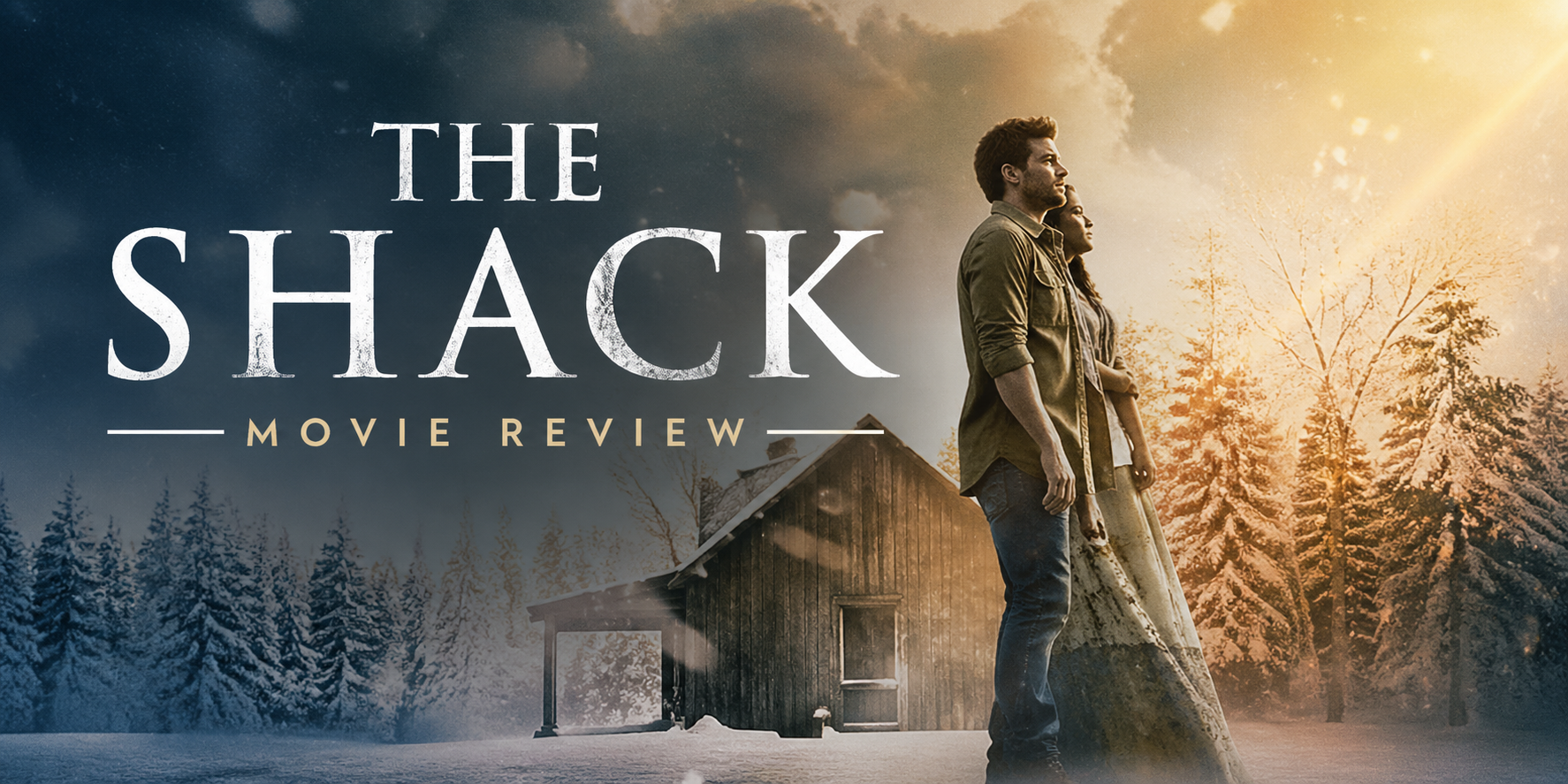

Synopsis of The Shack
The Shack follows Mackenzie Phillips, a man weighed down by grief after a devastating personal loss. When he receives a mysterious invitation to return to the place where everything went wrong, he’s forced to confront his greatest pain and the idea of God in a way he never expected.
NARRATION AND PACING OF THE SHACK
This is one movie that heavily questions some of the orthodox beliefs about God. The film opens quietly. Black screen, voiceover, and within seconds you already know what you are going to watch. It leans into fantasy and spirituality almost immediately, so there’s no confusion about its direction.
This is one of the Christian films that made strong use of signs, symbols and allegories. If you are the type that loves to find hidden meanings in movies, then this is definitely for you.
Irony plays a strong role early on in The Shack. Mack’s father is introduced as a church elder, yet he is abusive and deeply flawed. That contradiction sets the emotional tone for the entire story. It’s the film’s way of saying: belief and behaviour don’t always align.
The transitions between Mack’s childhood and adulthood are smooth but not overly explained, which works well. You’re given just enough to follow, but not everything is handed to you. It creates a thrilling suspense.
The film starts off with a medium/ fast pacing, lacing it with suspense. However by the middle of the film, the pacing becomes intentionally slow. This is not a film that is trying to keep you on edge. It’s trying to sit you down and make you listen. For some people, that will feel meaningful. For others, it might feel like the story is dragging its feet.
The movement between different stages of Mack’s life almost feels layered, like his past is bleeding into his present.
Thematic Depth & Message of the Shack
At its core, The Shack is about forgiveness, pain, sadness, and loss. Not in a surface-level way, but in a way that actually forces you to sit with uncomfortable questions.
The film leans heavily into the Christian idea of grace. Not the polished, Sunday version, but the messy one. The kind that asks: how do you forgive someone who doesn’t deserve it? And even deeper, what does it mean if God forgives in ways you don’t understand?
It doesn’t try to present God as distant or waiting to punish. Instead, it flips that expectation. God is shown as present, patient, and deeply invested in human pain. That alone challenges a lot of rigid beliefs.
Now, one important thing: the film does not give a full picture of justice or punishment for wrongdoing. It doesn’t dwell on consequences for evil in the way many people might expect. But that’s because it’s not trying to.
The focus is very specific. It is about Mack’s personal journey toward understanding God’s unconditional love. Not a courtroom version of justice. And that choice is deliberate.
Because the film is essentially asking: What if the point isn’t punishment, but restoration?
For some viewers, that will feel powerful. For others, it might feel incomplete or even frustrating, especially if they are expecting a more balanced exploration of justice.
Overall, the film guides the viewers into deciding by themselves what they want to eventually believe.
III. Technical Execution & Atmosphere
The cinematography in this film feels like emotion has been given a physical form.
Light is used almost like a character. Warm, glowing tones during moments of connection and peace. Cold, muted colours during grief. You’re not just seeing scenes, you’re feeling Mack’s internal state through them.
There’s a quiet confidence in how the film looks. It doesn’t overcomplicate things, but it knows exactly when to shift tone.
The cinematography doesn’t just frame the story, it translates emotion into light and shadow, like grief and healing are taking turns behind the camera.
Even the environment mirrors Mack’s mind. The messy, disordered spaces at the beginning reflect his internal chaos. Later, the more serene settings feel almost too perfect at first, like peace he hasn’t fully accepted yet.
Performance-wise, the young Mackenzie stands out. His pain feels real, not acted.
The sound design is subtle. It doesn’t try to force emotion. Sometimes the silence does more work than the music.
The Buts …
This is where the film stumbles a bit.
First, the pacing. While the slow approach works for the message, it can feel stretched. Some scenes linger longer than necessary, and for viewers who prefer tighter storytelling, it might feel like the film is repeating itself emotionally.
Second, the dialogue. At certain points, especially during the more spiritual conversations, it can feel slightly too polished. Almost like the characters are speaking in perfectly constructed thoughts rather than natural dialogue. That can pull you out of the experience a little.
Also, the film’s focus on love over justice can feel one-sided. By not fully addressing consequences for evil, it risks feeling like it is avoiding a harder conversation. Some viewers may walk away feeling that something important was left out.
And finally, the ambiguity. While it works artistically, not everyone will appreciate the unanswered questions. Some people want clarity, and this film is not interested in giving all of it. For example, the question if Mackenzie actually killed his father or if his mother committed suicide was never truly answered.
However, the portrayal of God, particularly as a woman initially, and the overall representation of the Trinity, might not sit well with more traditional viewers. But, the movie doesn’t promise to give you what you’ve always believed. It perfectly explained why God was initially represented as a woman and its psychological effect on Mack. It didn’t try to build a doctrine around it, it just shows that God can take any form He wants to, for any purpose He wants to achieve with us. For some, it will feel refreshing. For others, it may feel like a step too far.
This is not a background movie. You have to pay attention. It’s best for people who don’t mind slow pacing and are open to reflective, emotionally heavy storytelling.
Recommended if you enjoy:
- Deep, introspective films about healing
- Stories that explore faith in unconventional ways
- Narratives that leave you thinking long after they end.
Final Verdict:
It is definitely Worth a Stream
Though it may not be flawless, and its message won’t land the same for everyone. But if you’re willing to meet it where it is, The Shack offers something deeper than entertainment. It doesn’t try to answer everything. It just asks you to feel… and then decide what you believe.
Do you think it’s worth the watch? Do comment below. What’s your own verdict of the movie.
Makes a lot of sense#
It does Christian.
While watching the movie I was thinking Mack was too pained to forgive 😭 but if we all see deep there is one thing we have kept for long. The movie made me saw it.
Thank you for this beautiful review
You are welcome Maryjane