
I finished school. I want to say it simply like that because the simplicity of it is the point. After everything, after Professor Adeyemi, after the sleepless years, after Biodun, Peterson and Chuks, after the clinic and the library and the quadrangle at midnight, I sat my final exams, and I passed them, and I walked across a stage in a borrowed gown on a morning in November. I collected my certificate from the hands of the vice-chancellor, and I walked back to my seat.
My mother was in the crowd.
I had not told her most of what I have told you. I had told her enough, that I had struggled, that I had found help, that I was alright now. She had listened with the face of a woman who understood that her son was giving her the version he was able to give, and she had accepted it, because she was wise enough to know that some things are told fully only when the person telling them is ready, and that readiness cannot be rushed.
She cried when I crossed the stage. I saw her from a distance, a small woman standing and pressing her hands together, and something in my chest moved in a way that had nothing to do with the grade on my certificate.
The months before graduation had not been easy, but they had been different.
The weight lifted, but the guilt left gradually.
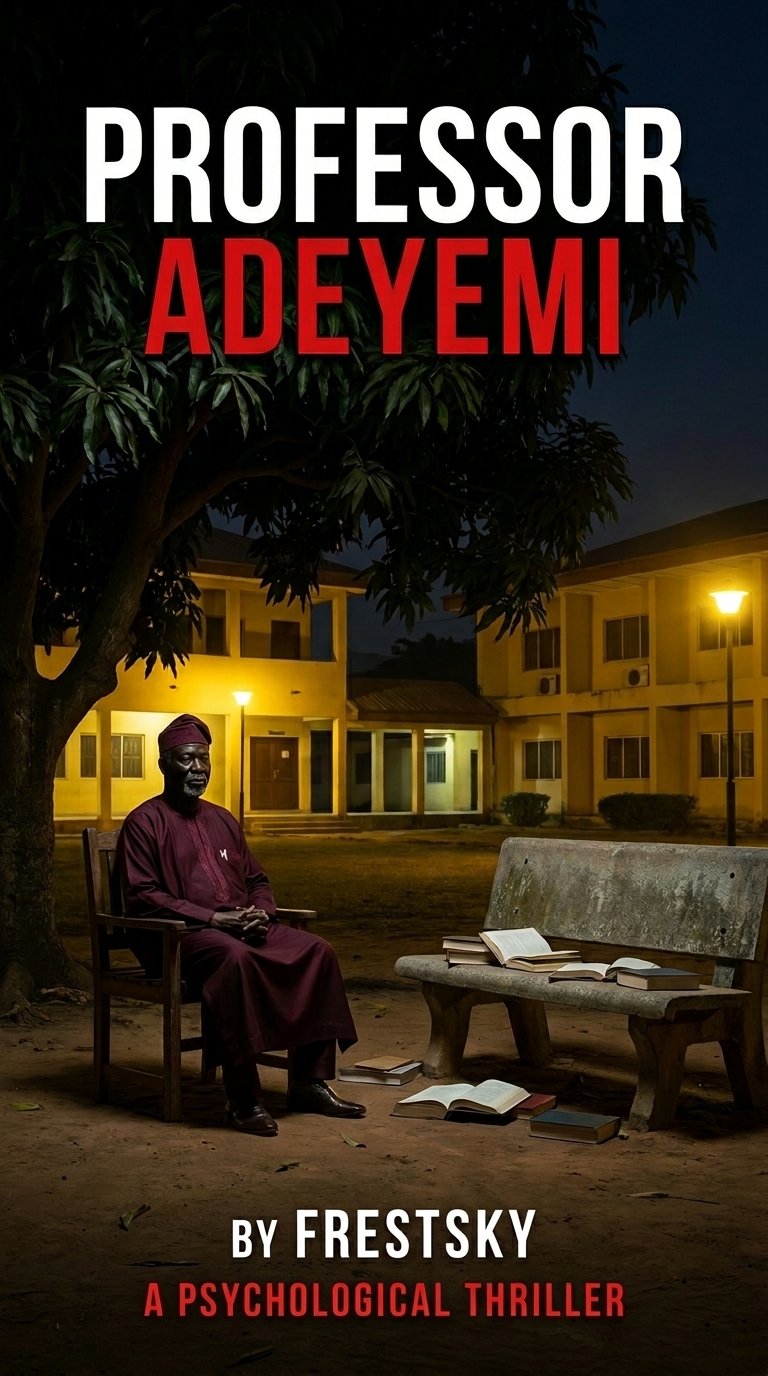
Professor Adeyemi did not return. Whatever had been using that face, that voice, that patient warmth, it was gone, and its absence was a different kind of presence in my life, one I had to learn to navigate. The quadrangle I avoided entirely for two months, then returned to once, cautiously, to find it simply a quadrangle, concrete benches, a mango tree, security lights, bats. The ordinary world, unoccupied.
My concentration came back slowly. My sleep came back more slowly. But they came.
Emeka sat with me through the worst of the final year. I told him, eventually, all of it, Rotimi, the game, the room, everything I had been not saying for three years. We sat in the room until very late that night, and when I finished he was quiet for a long time, and then he said: “You were seventeen.”
“Yes,” I said.
“That doesn’t make it nothing,” he said carefully.
“But seventeen is seventeen.”
I knew what he meant. I was not sure I fully agreed, but I understood what he was extending to me, and I received it.
“But I think I’d have to follow you to that church someday. Because whatever thing that could transform you in such a manner, I do want to see it.
Though we laughed about it, but he later became the so commited in the church before he left school.
I contacted the families of Biodun and Chuks.
Biodun I was able to reach directly, he had returned home, was doing better, was considering whether to reapply to university the following year.
Our conversation was short and careful, two people handling something fragile between them. We did not speak about Rotimi directly. We did not need to. The acknowledgement was in the call itself, in the fact of having made it.
Chuks’ family I reached through his older sister. He was still in the facility. Still recovering. His sister’s voice on the phone was the voice of someone who had been holding something heavy for a long time without being able to put it down. I told her I was sorry. I told her I hoped he would be alright. I told her to tell him that I had called. She thanked me and we said goodbye.
I put the phone down and sat with what I had not been able to fix.
Rotimi’s mother lived in Ibadan. I found her address through a secondary school contact who had stayed closer to home than the rest of us. I did not call ahead. I was not sure I would go through with it if I gave myself the time to reason my way out of it.
I took a bus to Ibadan on a Saturday in August, four months before my graduation. I found the street, found the house, a modest compound with a green gate and a small garden that someone tended carefully. I stood outside it for some time.
Then I knocked. She was smaller than I expected. I had constructed her in my mind over the years in various ways, sometimes as grief made large and formidable, sometimes as something more frightening than that. The woman who opened the gate was small and grey-haired and tired in the way of someone who has lived for a long time with a specific sorrow.
She looked at me.
I said: “My name is Tayo. I was in secondary school with Rotimi. I was one of the boys who…” I stopped. Started again. “I was there that night. And I have wanted to say something to you for a long time, and I am sorry it took me this long to come.”
She looked at me for a long time without speaking.
Then she opened the gate wider and said: “Come inside.”
I will not tell you everything that was said in that sitting room. Some of it is hers. The grief she carried and the choices she made in the depth of it, those belong to her, and she shared them with a precision and a dignity that I will not reduce by summarising. What I can tell you is that we sat across from each other for a long time, a woman who had lost her son and a young man who had been part of the reason, and we spoke plainly, and the plainness of it was the most difficult thing I had done in a long time and also the most necessary.
I did not ask her to forgive me. That felt like the wrong thing to ask, like making her grief perform a service for my conscience. I told her what had happened, from my side of it, as honestly as I could.
I told her how old we had been, not as an excuse but as a fact. I told her that I had thought about Rotimi for years and had not known what to do with that thinking, and that I was still not entirely sure, but that I had needed her to know that he was not forgotten.
She cried. Quietly, without drama.
I sat and let her cry. When she finished she looked at me with eyes that had seen a very great deal and said: “He just wanted them to like him. That was all he ever wanted.”
“I know,” I said. “I know that now.”
I think about Rotimi still.
Not the way I used to, not with the buried, pressurised quality of something that can’t surface without causing damage. More openly than that. More honestly. He comes to mind and I let him come, and I think about who he was and what he wanted and what was taken from him on a night when a group of boys were too young and too careless to understand the weight of what they were handling.
.
I was standing in the sun on the morning of my graduation, gown over my arm, waiting for the procession to begin, when Emeka appeared beside me. He had graduated the previous semester, was already employed, had come back for my ceremony because that was the kind of person he was.
He looked at me.
“You made it,” he said.
“I made it,” I said.
He nodded. He did not make anything more of it than that, which was correct.
The procession began to move. I fell into line with the others, the sun on my face, the campus around me, the boulevard of trees, the old faculty buildings, the mango tree at the centre of the quadrangle visible from where I walked. All of it ordinary. All of it simply what it was.