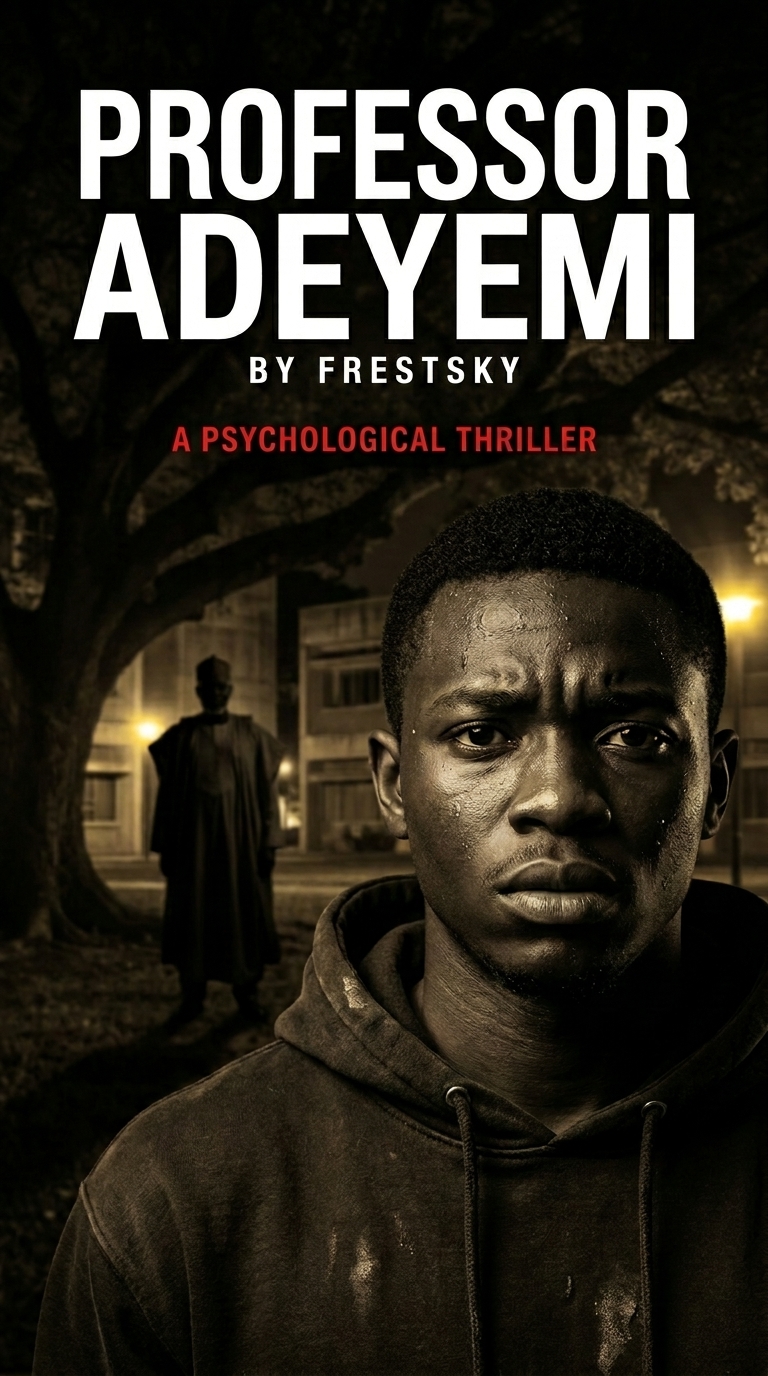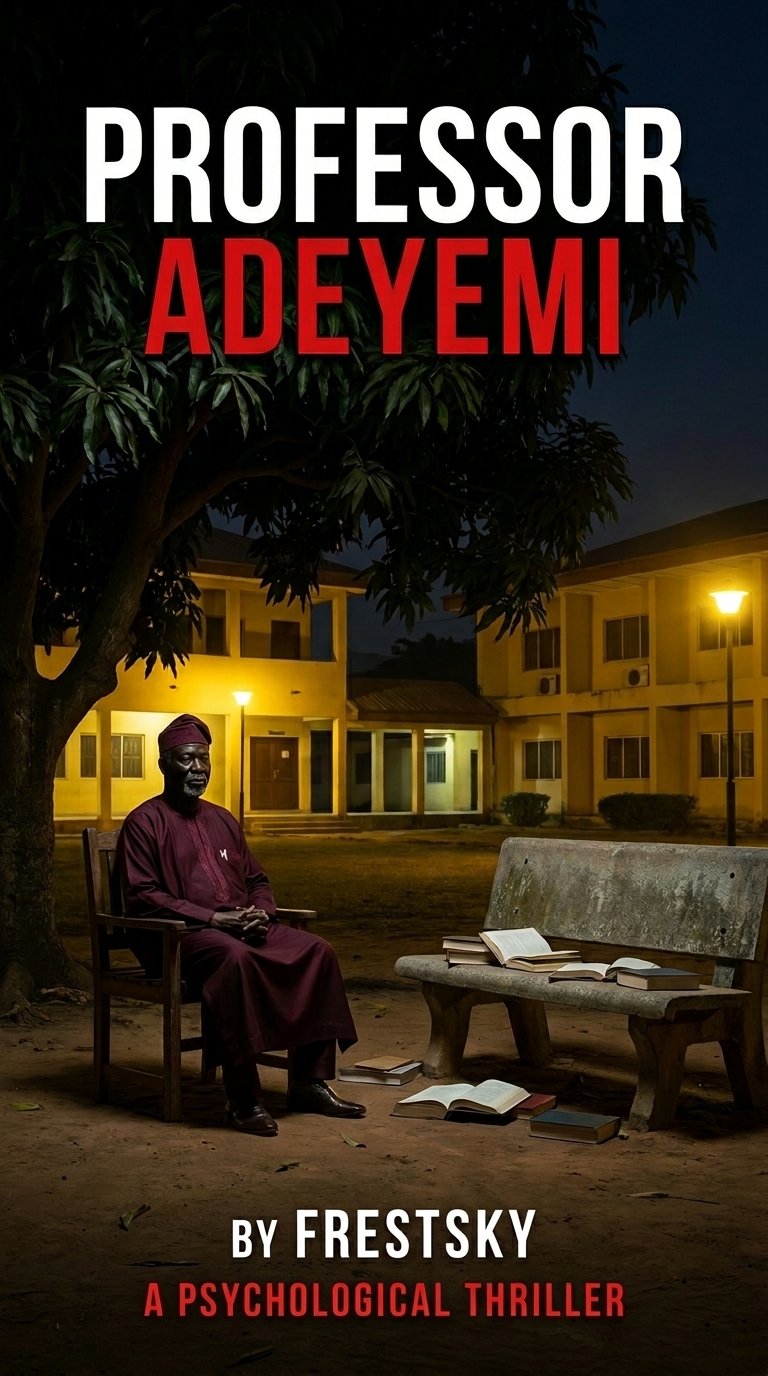

I did not go back to the quadrangle for another three days, nor did I see Professor Adeyemi. I told myself I was busy. I had coursework due, a group project that was going nowhere because one member had stopped attending meetings, and a test in my hardest unit to prepare for. These things were true.
But the main truth was that I did not know how to sit across from Professor Adeyemi now that I knew what I knew.
Rotimi’s name had surfaced in me like something that had been held underwater for a long time. Once it came up it did not go back down. I would be in a lecture, following the thread of an explanation, and then without warning I would be in that secondary school hostel room again, the low light, the circle of us, the game we had decided to play because we were seventeen and bored and because daring each other into things was what we did, what all of us did, what nobody thought needed examining until it was too late to examine it.
I shut it down every time. But it comes back faster each time, the way a door keeps opening in the wind after you have closed it.
My sleep was getting worse. The dreams were not always about Rotimi, sometimes they were formless, just pressure and dark and the sense of something very close that I could not see. But I would wake from them all the same, at two, at three, at four, with my heart doing things hearts are not supposed to do at rest and the ceiling of the hostel room above me offering nothing.
My work was suffering, I could feel the edges beginning to fray in the way I had felt them fraying in my first year, that familiar loosening of grip. I pushed harder to compensate, the way you grip tighter when you feel something slipping, but pushing harder requires sleep and I was not sleeping and the whole structure was beginning to feed on itself.
Emeka asked me three times if something was wrong. Both times I said no and changed the subject. Both times he let me, but the second time his expression told me he was keeping count and the third time he seemed to agree with Kunle about me going to see a pastor or just go to church at least.
On the fourth night, I went back. I had made a decision. The decision was this: I was going to sit across from professor Adeyemi and look at him clearly and ask him a direct question and watch what happened. I was a logical person. Logical people did not run from things indefinitely. They gathered information. That was what I told myself.
What I was actually feeling, walking across the campus toward the quadrangle was the slightly sick feeling of a reckoning.
He was there. Of course he was there.
I walked toward him. My mouth was dry.
“Professor,” I said.
He turned. He always turned slowly, the way a man who is never in a hurry because he has already decided how things will go.
“Good evening, Tayo,” he said.
I stopped a few feet from him. I looked at his face. I had looked at this man’s face across dozens of tutorials, in this quadrangle, at this hour, for nearly two years. I knew this face. That was exactly the problem.
“I need to ask you something,” I said. “And I need you to answer me honestly.”
Something shifted in his expression. Not alarm. More like the particular attention of a man who has been waiting for a specific question and is now watching it arrive.
“Ask,” he said.
I held the paper out toward him. He looked at it. He took his time; he was always taking his time, that was one of the things about him. Then he looked up at me and said nothing.
“Who are you?” I asked. “I mean really. Who are you?”
The leaves of the mango tree moved behind him. There was no wind where I was standing. I had been noticing things like that for months. Small things. The way the shadows around him sometimes didn’t behave the way shadows should. The way I would turn suddenly and catch something at the edge of what he was, a wrongness I couldn’t name, like a word you recognise but cannot pronounce.
I had filed these things away, and like Mary, I kept them quietly, in a part of my mind I kept separate from the part that needed to pass exams. That part had always won the argument.
Until three days ago, when I found out the truth.
“You already know,” he said. He said it quietly, gently, almost. “You have known for some time. That is why you came tonight.”
“Then say it,” I said. “If I already know, then just say it.
He smiled. And then he was not there…
You already know what happened next. I have already told you. Johnson the security guard. The clinic. The white ceiling. Coming back to myself slowly, like light through a window that someone opens by degrees. I will not dwell on it. The embarrassment of it belongs to me and I have made my peace with it. What I want to tell you about is what came after.
I spent one night in the clinic. The doctor who saw me was a tired young man who asked me in a careful, neutral voice whether I had been under significant stress, whether I was sleeping, whether I had eaten properly that day. I answered yes, no, and I could not remember, in that order. He told me that the combination of sleep deprivation and academic pressure could produce experiences that were difficult to distinguish from something more serious, and that I should rest, eat, and consider speaking to a counsellor.
I thanked him. I went back to the hostel.
Kunle looked at me when I came in and did not ask where I had been, which told me that someone had told him. He handed me a plate of rice he had somehow obtained and sat quietly on his side of the room while I ate it. I also observed that either Emeka had helped me clean up my corner, or washed my dirty plates and clothes. That small, wordless kindness was one of the more decent things anyone did for me during that period.
Emeka came back the next morning. He sat on the edge of my bed and looked at me and said: “Talk to me.”
So I talked.
Not about everything, not about Rotimi, not about the part of this that I was least equipped to say aloud. But I told him about Professor Adeyemi. About the tutorials. About Emeka not seeing him, about the registrar, about the library archive, about the memorial page. I told him about the photograph and the dates on the label. I told him what Professor Adeyemi had said at the end, before he disappeared.
Emeka listened without interrupting, which was not always easy for him. When I finished, he was quiet for a moment.
“Tayo,” he said. “I have to tell you something.”
“Tell me.”
“That evening. When I waved at you in the quadrangle.” He paused. “I didn’t move for a long time, because I saw you actively interacting and speaking to someone beside you but you were all alone. I remembered you told me you had a meeting with the professor. At first I thought it was stress, I even thought it was drugs. In fact I thought a lot of things, that’s why I rushed to see you that night.”
I had known this. On some level I had known it for months. But hearing it said plainly, by someone I trusted, was different from knowing it in the private space of your own suspicion.
“Okay,” I said.
“What are you going to do?”
I did not have an answer to that. I stared at the ceiling. The same ceiling I had been staring at for months in the wrong hours of the night.
“I don’t know,” I said.
Professor Adeyemi stopped appearing in the quadrangle. I went back twice, three times, four times, because I did not know what else to do and the quadrangle was still where my mind worked best and I had exams approaching and I needed to study somewhere. He was not there. The mango tree stood empty. The bench was just a bench. I told myself this was good. I told myself it was over, that whatever it had been, stress, hallucination, something I had manufactured out of desperation and sleep deprivation, had run its course, and I could now return to being the rational person I was and finish my degree.
I almost believed it.
Then the other things started.
The first was a sound.
I was in the library, three weeks after the clinic, sitting alone at a corner table with Emeka’s laptop and my notes and the library was almost completely quiet. I was reading when I heard something. A voice. Low, close, saying my name.
I looked up. The nearest student was four tables
away, facing the other direction. Nobody was near me. I looked around the section entirely. Nothing.
I went back to my reading.
Twenty minutes later, again. Tayo. The same voice. The same proximity, as though someone were sitting directly across from me and had said my name at a normal conversational volume. It was Professor Adeyemi’s voice.
I closed my laptop. I packed my bag. I left the library and walked back to the hostel quickly and did not look behind me, because some part of me did not want to find out what I would or would not see if I did.
After that it was not always a voice.
Sometimes it was a weight, the particular heaviness of a presence in a room that manifested as a change in temperature, a shift in the air. I would be alone in the room and then the room would feel occupied, and I would sit very still and breathe carefully and wait for it to pass.
Sometimes it was my concentration simply stopping. Mid-sentence, mid-thought, mid-calculation, as though something had reached into my mind and closed a fist around the thread I was following, and when the fist opened again the thread was gone and I had to find it from the beginning.
My grades began to fall. It was gradual, which was almost worse because it was harder to point to and say: here, this is the moment. My test scores came back lower than they should have been. My assignments were taking twice as long and producing half as much. The clear, structured thinking that Adeyemi’s questions had rebuilt in me was becoming muddy again, unreliable, full of gaps.
I started missing lectures. Not intentionally. I would wake in the morning intending to go and then sit on the edge of the bed and time would pass and I would look at the clock and the lecture would be half over and I would not be able to reconstruct how the morning had disappeared.
Kunle started waking me up before he left for his own classes. He did this without being asked, without making anything of it, setting his alarm fifteen minutes earlier than he needed to and shaking my shoulder on his way out. I do not know if he knew how much it mattered.
Emeka came most evenings. He did not always stay long, sometimes just long enough to drop food and confirm I was still functional. But even with all of that, I was slipping. I could feel it the way you feel the pull of water in a current, not violently, not all at once, just the persistent, patient drag of something that is stronger than your effort to resist it.
It got worse the weeks that followed. Sometimes I see him from the window smiling at me outside the lecture hall and then he disappears.
I started to hear voices, especially his voices. Sometimes as whispers and sometimes as loud laughters. Once it was sure, I was slowly going insane.